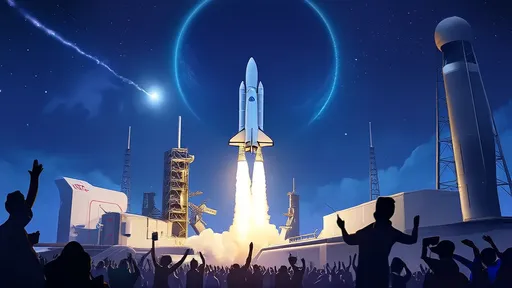
In a historic milestone for space travel and global transportation, SpaceX has successfully launched its first commercial Starship flight, marking the beginning of a revolutionary 90-minute global travel service. The long-awaited mission, which took off from Starbase in Boca Chica, Texas, demonstrated the viability of point-to-point Earth travel using reusable spacecraft—a concept once confined to science fiction.
The fully stacked Starship, consisting of the Super Heavy booster and the Starship upper stage, roared to life with its 33 Raptor engines generating over 16 million pounds of thrust. After a flawless ascent, the booster separated and executed a precision landing back at the launch site, while the Starship continued its suborbital trajectory at speeds exceeding Mach 20. The spacecraft completed its demonstration flight by splashing down safely in the Pacific Ocean near Hawaii, just 89 minutes after departure.
"This changes everything," declared SpaceX CEO Elon Musk during the post-flight press conference. "We've just proven that long-distance travel can be measured in minutes rather than hours. The implications for business, diplomacy, and human connectivity are staggering." The successful test opens the door for scheduled commercial operations, with SpaceX announcing initial routes connecting major cities like New York to Shanghai, London to Sydney, and Dubai to Los Angeles.
The cabin configuration revealed during pre-flight tours showcases a premium travel experience unlike conventional airliners. With capacity for 100 passengers in business-class style seating, the pressurized cabin features panoramic windows for viewing Earth's curvature, zero-gravity moments during flight, and advanced vibration dampening systems. SpaceX has partnered with luxury hospitality brands to provide gourmet meals and personalized service during the brief journey.
Safety remains paramount for the groundbreaking service. Each Starship incorporates multiple redundant systems, including emergency abort capabilities during ascent and descent. Passengers will undergo specialized training similar to astronaut preparation, though significantly condensed. "We're not just transporting people," explained SpaceX's Chief Operating Officer. "We're introducing them to space travel in an accessible, repeatable way. This is about normalizing Earth-to-Earth spaceflight."
Industry analysts predict the $20,000-$50,000 ticket prices will initially cater to business executives, government officials, and affluent travelers, but costs are expected to decrease dramatically as flight frequency increases. SpaceX plans to build a fleet of Starships dedicated to terrestrial travel, separate from those destined for lunar and Mars missions. The company aims to achieve multiple daily flights per vehicle through rapid reusability—a key innovation that makes the business model feasible.
Regulatory hurdles presented significant challenges in bringing the service to fruition. SpaceX worked closely with the FAA, international aviation authorities, and coastal nations to establish new frameworks for suborbital point-to-point travel. The collaboration has resulted in the world's first integrated space-air traffic management system, capable of handling both traditional aviation and frequent space launches without disrupting global air travel.
Environmental concerns have been addressed through the spacecraft's methane-fueled Raptor engines, which SpaceX claims are carbon-neutral when using sustainably produced fuel. The company has committed to offsetting all emissions during the initial operational phase while developing more eco-friendly propulsion technologies. Critics argue more independent studies are needed, but environmental groups have cautiously welcomed the potential reduction in long-haul aviation emissions.
The first paying customers are expected to board within eighteen months, following additional demonstration flights and crew certification processes. Early adopters have already begun reserving seats through SpaceX's newly established Starship Travel division. Corporate contracts with multinational companies and several government agencies have reportedly been signed, though details remain confidential.
As the world processes this transportation revolution, competing projects from Blue Origin, Virgin Galactic, and aerospace consortia in China and Europe are accelerating their own suborbital travel programs. However, SpaceX's first-mover advantage and proven launch capabilities position it as the undisputed leader in what analysts are calling "the second space age"—one focused as much on transforming Earthbound travel as on interplanetary exploration.
The successful commercial debut of Starship Earth-to-Earth service represents more than just a technical achievement; it signals a fundamental shift in how humanity perceives distance and time. As one aviation historian noted: "This is the 21st century's equivalent of the jet age. We're witnessing the birth of an entirely new dimension in transportation." With regulatory pathways established and technology proven, the era of global travel measured in minutes rather than hours has officially begun.
By /Jun 20, 2025
By /Jun 20, 2025
By /Jun 20, 2025

By /Jun 20, 2025

By /Jun 20, 2025

By /Jun 20, 2025
By /Jun 20, 2025
By /Jun 20, 2025

By /Jun 20, 2025

By /Jun 20, 2025
By /Jun 20, 2025

By /Jun 20, 2025

By /Jun 20, 2025

By /Jun 20, 2025

By /Jun 20, 2025

By /Jun 20, 2025
By /Jun 20, 2025
